- P. O. Box 68– 40100 Kisumu, Kenya.
- neri.boyz.kisumu@gmail.com WhatsApp: +421 907 787 822
- Mon - Sun 9.00 - 18.30 Karibu mgeni mwema!
SPNR Staff
The core of our team has remained unchanged since our inception in 2016. Other parts have expanded and changed over the years.
So here is our current lineup.
OUR FOUNDERS/LEADERS
The SPNR center was officially registered under both Slovak and Kenyan authorities at the year 2016. However, the beginning of our formation dates back to 2014.
The two founders of our center are also the current leadership duo. The Director T. Rusňák and the Manager V. Ochieng.
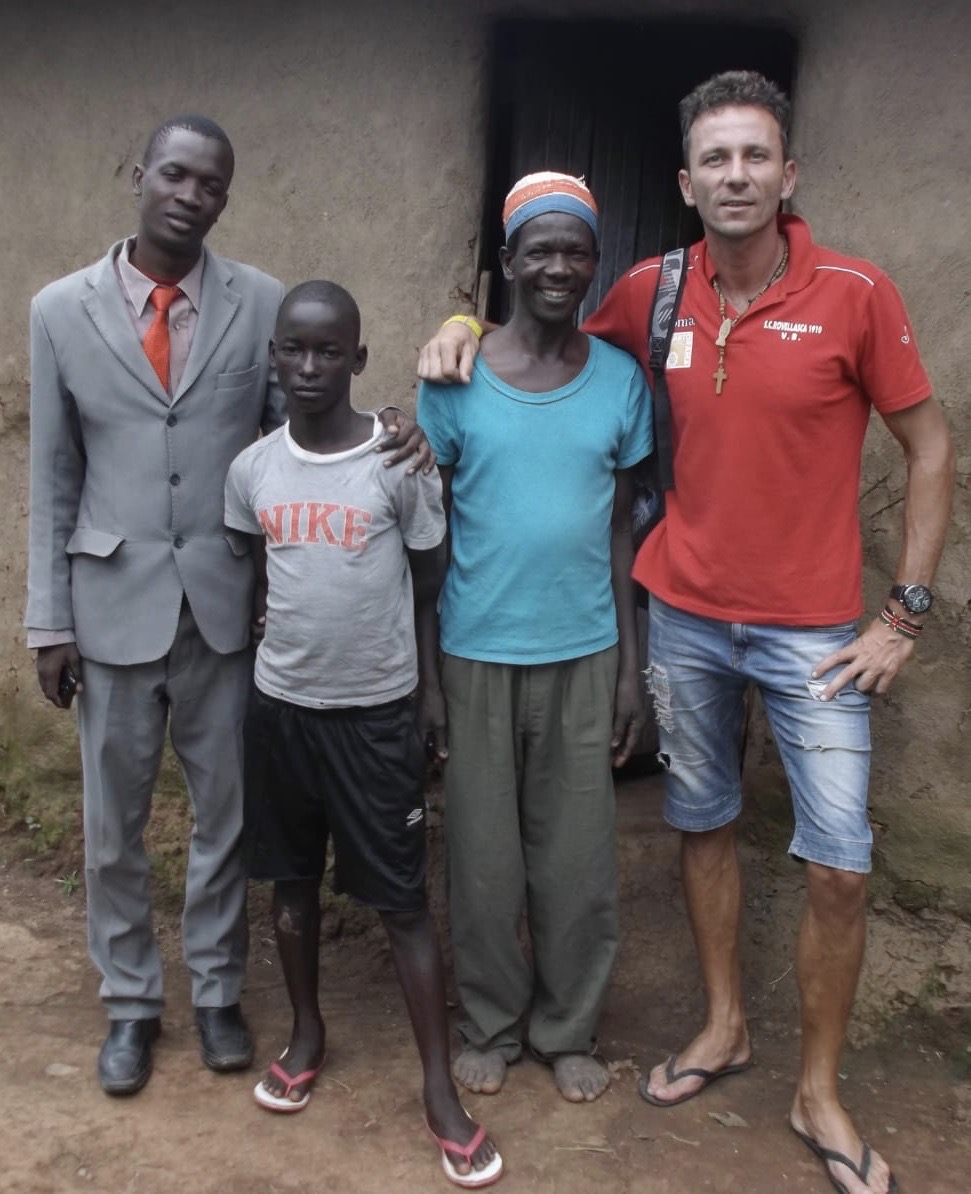
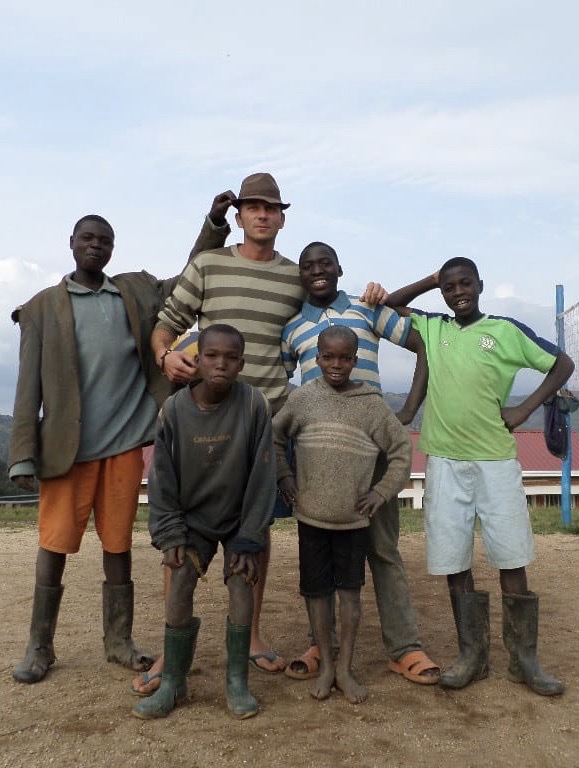
Founding Fathers and current leadership duo
The shortened Inception story
Our Director Tomáš Rusňák works on the African continent since 2010. In 2013 he joined the missions of St. Elizabeth University. At 2014 he was occupied with directing or supervising several different projects (details below on the page) scattered around the country. At that time, however busy he was, his today's mission was able to find him.
After two years of assisting Kisumu street children he first met with local social worker Vincent Ochieng, who came up with the idea of establishing an organization.
By putting their knowledge, skills and hearts together, the SPNR selflessly provides a comprehensive help within the local community until today. Under their leadership and under the auspices of the St. Elizabeth University.
Tomáš Rusňák Omondi
The Director
Mr. Rusňák began his African story in the year 2010 as he joined the sudanese humanitarian mission with the Salesians of Don Bosco, where he has been volunteering with the youth of the local community. At first he assumed it would be a one-time experience. However, just as many noble-minded adventurers, he fell in love with Africa and found his path in following Christ's message
Mr. Rusňák set out on his second African mission in 2013, already operating under the baton of the University of St. Elizabeth. That time he went to Rwanda to volunteer in the Blessed Clémentine-Anuarita Healthcare centre in Bigugu, where he served one year. In 2014, the University's allocation mannagement sent him to manage a malnutrition project in the town of Muhoroni, where Mr. Omondi lived up to his task for another twelve months.
The next one-year challenge waited for our Director in the city of Naivasha (in 2015), where he guided the St. Therese Development Center, a rehab for sexually or physically abused children. While leading this project he was commisioned to oversee the submission of the Malindi supportive program (almost 700km apart), where he later also worked in the period 2016-2017.
While serving in Muhoroni, Omondi used to visit nearby Kisumu in his spare time. At this place he came into the contact with local street boys. Since then he used to visit them on their spots, assisting them with food, clothes and other basic needs, including a genuine attention. Our current Director continued to visit Kisumu children irregularly for two years, although he had many other duties and responsibilities throughout Kenya (see above).
In 2016, while on one of his aid rounds he met Mr. Vincent Ochieng, a social worker who carried out similar humanitarian activities within the city centre. After a short interplay period and observing each other's approach, skills and experience they decided to elaborate a joint, humanitarian project aimed at a comprehensive, effective and long-term upbringing of chokora wa Kisumu (streetboys of Kisumu).
After the presentation of the new project and its subsequent approval by the University project department, Mr. Ochieng was ready to apply for permits to the relevant local authorities and to find out how to implement the intended methodics and targets of the mission within the legal conditions and in accordance with the allocated budget.
As Mr.Vincent Ochieng dealt with the bureaucracy, Tomáš successfully delegated the project in Naivasha to his successor. The following year he commuted between the shores of Lake Victoria and the Indian Ocean. Until 2017, he directed the Malindi mission in parallel. After the end of his term he was able to devote himself fully to Neri Rehab with his manager.
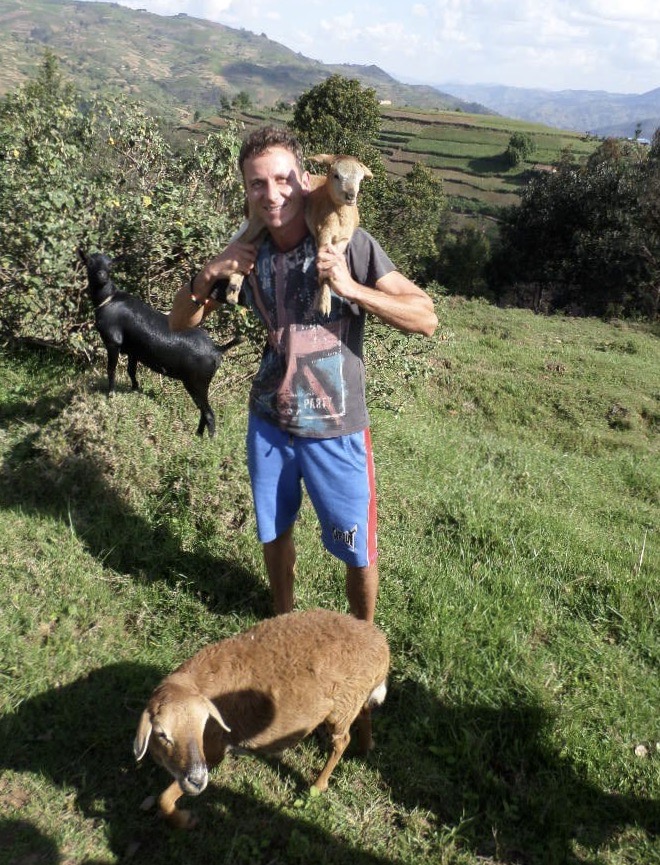
Omondi
Tomáš Rusňák was born in the small, western Slovak village Závod in 1979. He graduated from highschool in the year 1999 and currently is attending the distance course in Missiology and Charity Work at the St. Elizabeth University.
Mr. Rusňák participates in humanitarian projects in East Africa since 2010. Since the year 2016 he has been the director of the rehabilitation center for street children in Kisumu town which he co-founded.
At this place he was given the name 'Omondi', which in the language of the Luo tribe designates the one who 'was born early in the morning'.
Director's Duties
Omondi's position is quite versatile. In addition to the standard responsibilities of the director he also performes the role of logistician.
A logistician's task is to flexibly cover the various tasks necessary for the operation of the organization.
Material Provision
~ ensuring sufficient food supplies, basic hygiene needs, first aid supplies, drinking water, adequate condition of the dwelling and beds, etc.
~ responsibility for stock of school supplies and uniforms, suitable clothing and footwear
~ maintenance and decoration of the dwelling
Case Management
~ ensuring a standard process of integration into the collective and into the rehabilitation process
~ organisation and conducting of home visits
~ individual counselling and raising of children in the advanced stages of our rehabilitation program
~ evaluation of various requests for assistance in a personal crisis
solving different kinds of school attendance related issues
Treasury Holder
~ bookkeeping and issuing financial reports for the mother institution (St. Elizabeth University) and issuing reports for both the sponsors and leadership of the University
~ allocation of the project budget
~ obtaining external financial resources
~ employee payments
Vincent Ochieng
The Manager
Mr. Ochieng has a lot of understanding and empathy toward the sad fates of the abandoned ones. Immediately after completing the studies of biochemistry he decided to dedicate his life endeavour to the community, as he has been blessed with the chance to choose the way of his life as one of the few. Thus he discovered his life mission- to reach the suffering street children and their families, to help them walk towards the better future.
Vincent was born in 1991 in the town of Kisumu on the shores of Lake Victoria. From the time he first opened his eyes it must have been clear to him that the life he was born into would not be a bed of roses. His mother was not the only mother of his father 's children, so he had to share an already modest diet with many siblings from early childhood. after the early death of the breadwinner, the family remained in a desperate situation. As a result, little Vincent found himself on the street, left to fend for himself. He had to procure food and other necessities at his own.
He spent his childhood and adolescence in various orphanages, dependent on the favor of benefactors. Due to local conditions, he often ended up on the streets again. The older he got, the more often he found himself there again. Despite everything, he managed to graduate from high school.
He never lost faith and inner strength, along with innate versatile brightness and dexterity, he managed to turn his direction. After being baptized around the age of twenty, he managed to get a sponsor for the university studies. He got to study biochemistry at the University of Karatin, which he completed with a bachelor's degree. At that time, he was already a town's well-known figure. Thanks to an unusually varied life he used to get into contact with people of all kinds and backgrounds. As mentioned, he decided to devote his both social and naturalistic intellect to altruism.
Shortly after he started working in various social projects, he met Tomáš Rusňák. Tomáš, with extensive experience in the operation of various humanitarian organizations, began to create an excellent tandem with Vincent, an expert on all aspects of the life, needs and habits of street boys. After a certain period of cooperation, they decided to set up their own project, which would provide children not only with short-term rescue, but also with perspective for the future.
Thanks to his life story about a lotus flower that bloomed from the mud, he knows how to understand, guide and help today's street children to the same reversal of the unfair adversity. That is why he is known throughout the city as "odijo vincent" (Vincent the Teacher).
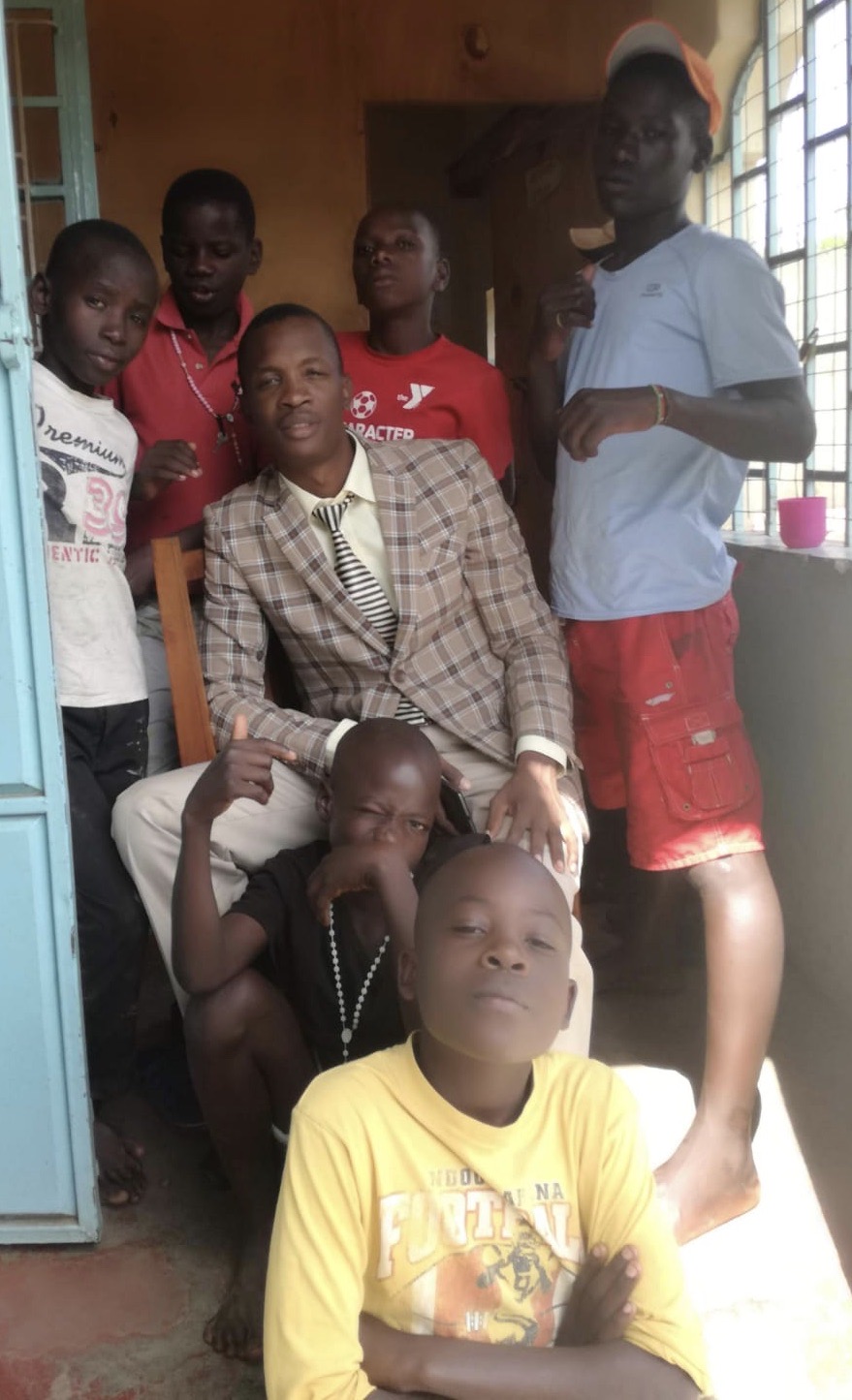
Odijo Vincent
The core of Odijo's approach is to help individuals realize the power they have over their destiny and thus lead them to seek actively the self-transformation by pursuing meaningful short-term goals:
'triffles form the perfection, but perfection is not a triffle'
(Michelangelo Buonarotti).His philosophy by reaching this objective is to help the wanderers to self-confidence, to understand the value of their own life, thoughts, body and the overall, unique perspective of the world. According to Mr. Ochieng, success lies mainly in the awareness of the meaningfulness and effectiveness of one's own efforts.
Manager's Role
The duties of Mr. Ochieng as a manager are quite typical. He is responsible for the employees and for the representation of the centre at official level.
However, Vincent does a lot of extra work by engaging his life experience
Officialities and Bureaucracy
~ ensuring and performing proper communication and relations with the local state authorities
~ carrying out the communication and relations with the associations of similar humanitarian institutions
~ solving various unexpected events and situations at the official level
Human Resources
~ responsibility for adequate training of staff and their updating (in case of: new general measure or regulation issued by state authorities / newly adopted child with special needs / social crisis, etc.)
~ comprehensive evaluation of: employee approach to the children, work deployment, means of issue-solving
~ organisation, setup and chairing of staff meetings
~ partial evaluation of assigned trainees and their tutoring
Social Work
~ organization and performance of field work (for the purpose of: monitoring the current situation, assistance of children in urgent need, establishing a relationship with potential admissions, training of staff members)
~ counselling of particularly difficult cases
~ counselling of adolescent pupils in the centre

Timotej Mikluščák Onyango
Logist
Timotej Mikluščák ‘Onyango’ first came to Kenya in 2018 for a period of seven months. He was originally assigned to a VŠZaSP project in Malindi, but after a few months he was transferred to Kisumu, where he strengthened the team of our SPNR centre at a time when it was necessary to quickly stabilize its operations.
He began his work as a logistician, with primary responsibility for ensuring the day-to-day functioning of the centre – from supplies and organization of the daily schedule to meeting the basic needs of the children. Over time, however, his role naturally expanded. He began working closely with social workers, participating in home visits within local communities and actively contributing to addressing the individual life situations of the children, which often required not only organizational skills but also patience, understanding, and the ability to find solutions in challenging conditions.
In addition, he became involved in the educational activities of the centre, co-leading morning classes together with the social workers. Daily contact with the children and the opportunity to witness their progress and personal growth became one of his strongest motivations to continue this work.
Over time, he developed a deep connection to the city of Kisumu, its people, and especially to the street-connected children. Even after returning to Europe, this place remained an important part of his life. Despite his studies and later the limitations caused by the COVID-19 pandemic, he repeatedly sought ways to return. In 2021, he was able to come back to Kisumu, where during a three-month stay he was entrusted with creating the SPNR centre’s website. He continues to manage it to this day, helping to connect the centre with supporters in Europe.
Since 2018, he has spent a total of more than two years in Kisumu working directly with the children. During this time, he became fluent in Swahili and is gradually learning the local language, Dholuo, which allows him to better understand the environment and the people he works with. This also enables him to communicate effectively, help resolve conflicts, and build trust between the children, the community, and the centre’s team.
Unlike the centre’s director, he is not based in Kisumu permanently. In Europe, he works on an organic seed farm in Austria, while remaining actively involved in the SPNR project. He regularly presents the work of the centre at public events, schools, and in the media, contributes to organizing fundraising activities, and ensures the ongoing management of the centre’s website.
In his own words, each time he leaves Kisumu, he does so with the hope that he will return again to continue the work that gives his life meaning.
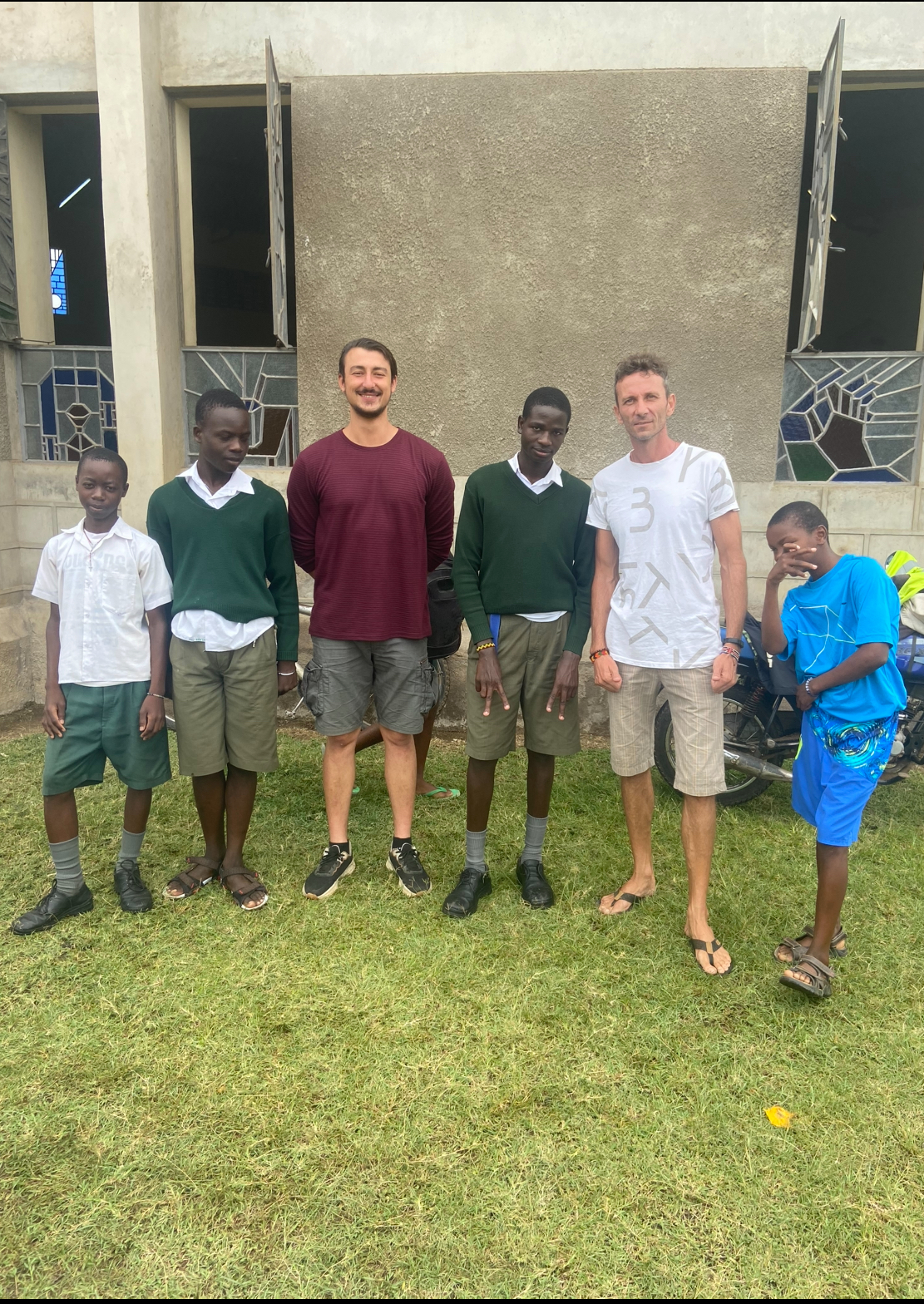
Onyango
Timotej Mikluščák was born in 1999 in Devín, near Bratislava. He graduated from a bilingual high school in 2018 and shortly afterwards left for East Africa, where he first became involved in humanitarian work.
He later trained in Austria as a vegetable grower, a profession he continues to pursue today. Since 2018, he has spent more than two years in Kisumu, actively contributing to the work of the SPNR centre.
Alongside his work in Europe, he regularly returns to the centre for work and mission stays, remaining an active part of the project.
In Kisumu, he is known by the nickname “Onyango”, which in the Dholuo language means “one who was born in the late morning.”
Logistical Responsibilities
Timotej Mikluščák’s role within the SPNR centre combines fieldwork with ongoing support of the project from Europe.
During his stays in Kisumu, he is involved in the daily running of the centre and collaborates closely with both social workers and management.
Support of Centre Operations
~ ensuring the smooth day-to-day functioning of the centre during his stays (organization of daily routines, supervision of activities).
~ assisting with the provision of basic material needs for the children (food, hygiene supplies, school materials).
~ contributing to the maintenance and improvement of the centre’s environment.
Field Collaboration and Education
~ participating in home visits to the families of the children together with social workers.
~ supporting the resolution of individual cases and the reintegration of children into everyday life.
~ assisting in communication and fostering mutual understanding between children, the community, and the centre team.
~ co-leading the centre’s morning educational program.
~ providing individual support and contributing to the personal development of the children.
Project Support from Europe
~ management and development of the SPNR centre’s website.
~ presenting the centre’s work at public events, schools, and in the media.
~ organizing and supporting fundraising activities to sustain the centre’s operations.
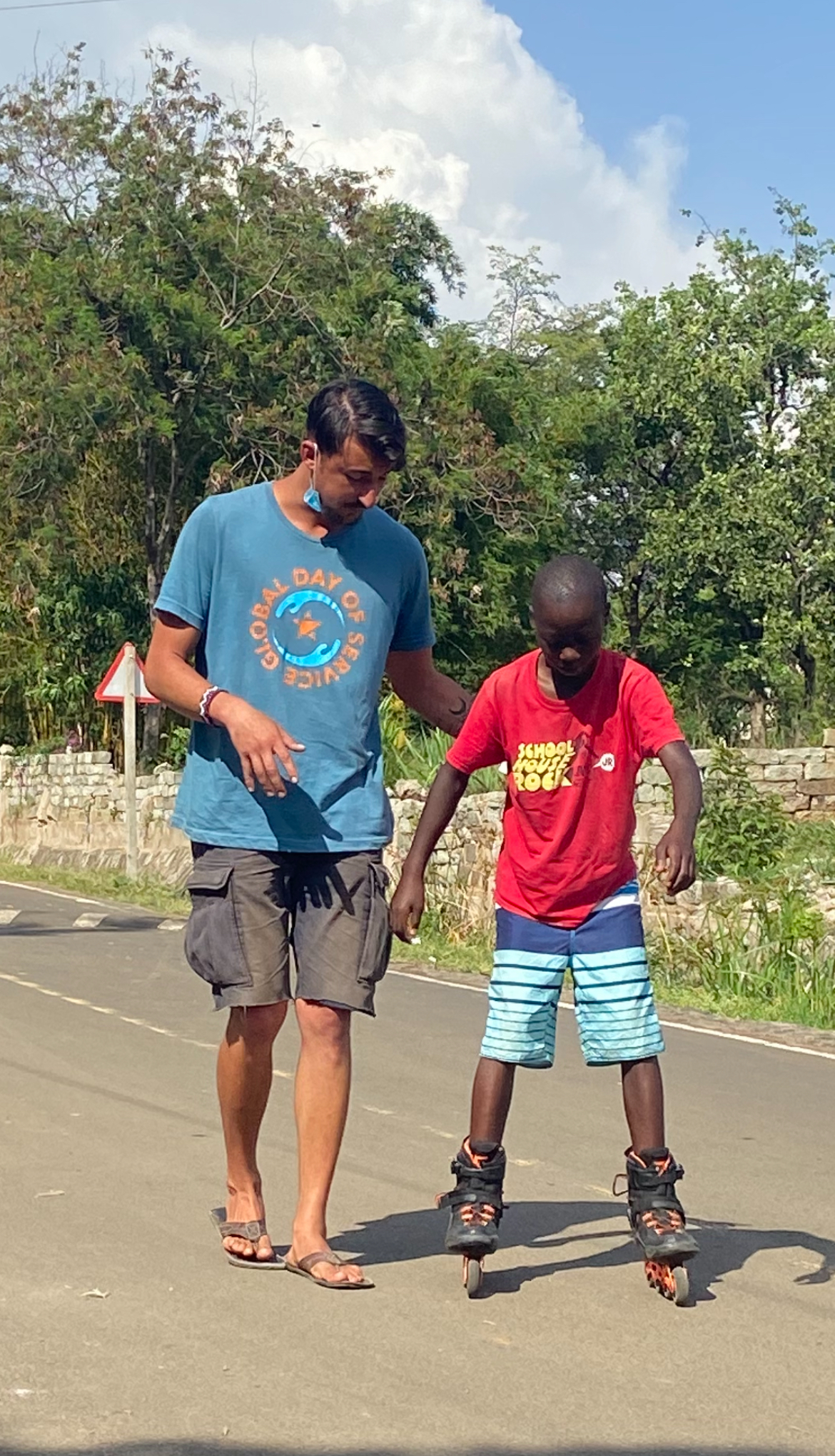
OUR SOCIAL WORKERS
At present, three social workers are an executive part of our team, ensuring the smooth running of our key activities in terms of communication, bureaucracy and education.
Odijo Moses, Pamela and David take turns in the service so at the center is always present a capable communicator of local languages and, at the same time, a vigilant supervisor.
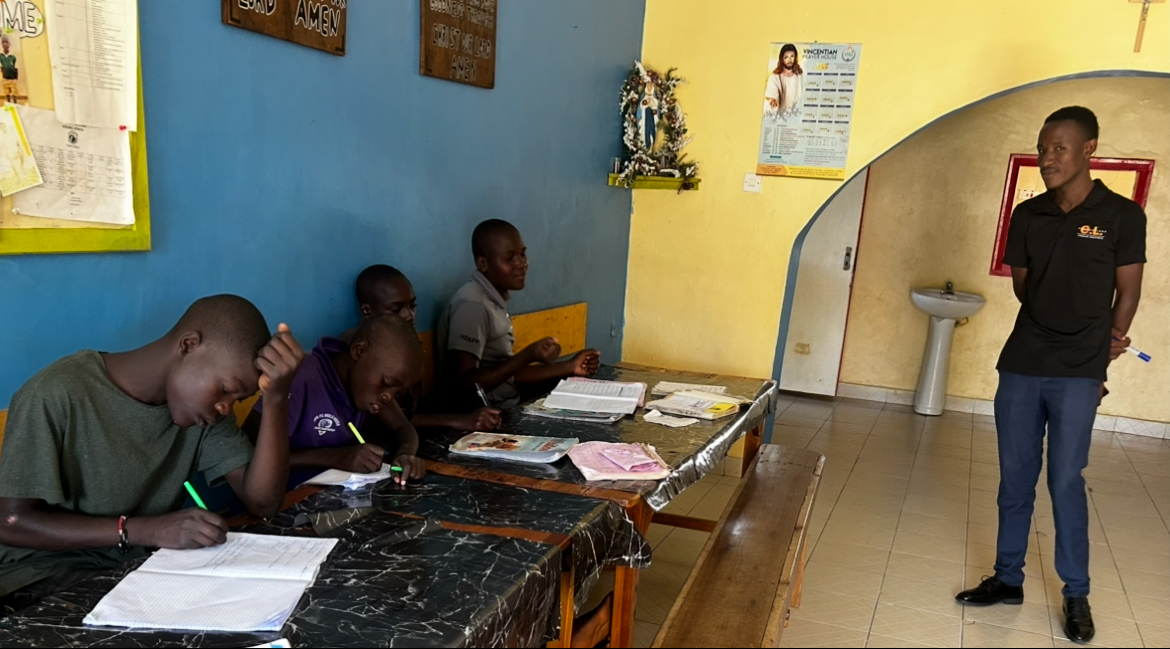
Morning classes
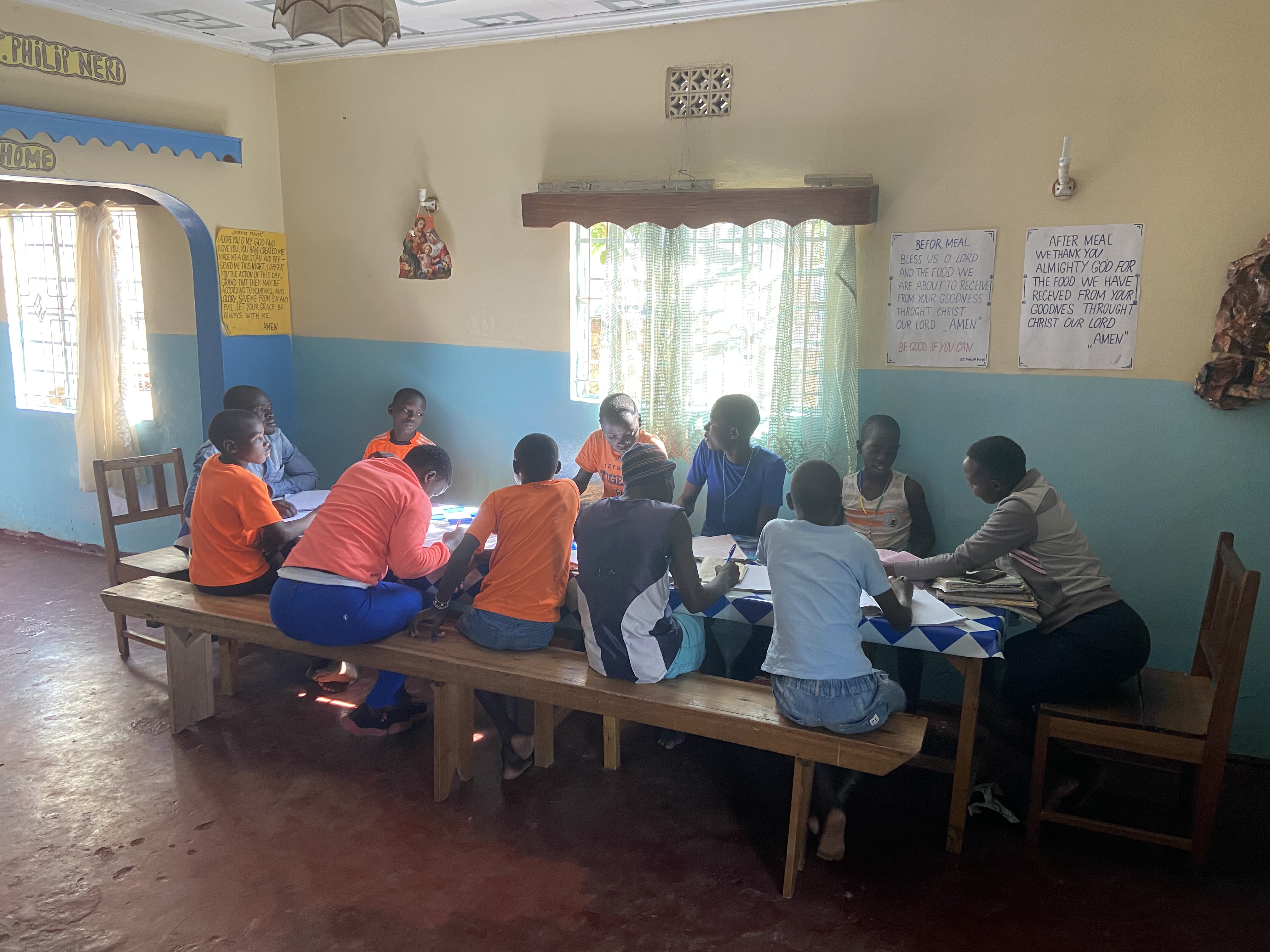
Odijo David teaches our boys the basics of English.
Staff number growth
At the beginning of our activity the SPNR team counted two employees only, these were the today's leadership duo. That time Tomáš and Vincent were supposed to ensure everything regarding complex case management, officialities and basic background.
From our inception, the team expanded to eight staff members (nine, if occasional personnel assistance from Slovakia is present). In addition to the duo of superiors, there are three social workers, a psychological counselor, one night watchman, a cook and, alternately, help from Slovakia in the form of a volunteer or in the form of an intern from a local university.
Moses Ochieng Omeno
Secretary, Teacher, Social Worker
Moses Ochieng has been a honorable citizen of Kisumu since birth in 1989. His knowledge, opinions / advices and skills regarding the city and its people, a multifaceted commitment, all this (and much more) makes him indeed a priceless base for Neri Rehab team.
Mr. Ochieng is part of our daily routine every second and fourth week of the month (alternatively by appointment), then Odijo lectures on our morning tutoring lessons. These last until lunch, after he plays a tandem with Mrs. Amondi. Together they take care of general order, boys' behavior, daily schedule, and more. For the remaining two weeks, he and Watchman Kevin guard a quiet, undisturbed night.
At the beginning of the admission to the Center, it is Ochieng's task to observe the first moments of the newcomer in SPNR, then to share his impressions with other competent employees. In the case of a positive assessment, admission may continue with a detailed dialogue (in the child 's mother tongue) about the life story, family background, history of abuse, etc. Moses is then a guide to rehabilitation and family visits, and in later stages also to the child's progress.
As secretary, Odijo Moses is responsible for communicating and handling minor official matters with the authorities, for processing the course and conclusions of staff meetings, as well as for weekly meetings with boys and day staff. He is also entrusted with the care and organization of records about our children.

Odijo Moses
Odijo Moses is a native Luo (Kisumu's main tribe, 4th largest in Kenya). Thus he is able to speak even Kiswahili and Kisii languages (and English, of course), which makes him the pillar of contact with kids and their families.
Mr. Ochieng recieved a diploma from 'Social Work and Community Development' after 4 years of study at The Kisumu National Polytechnic. After several internships, in the first half of 2018 he became the first field employee of our center (besides Tomáš and Vincent).
Pamela Amondi
Teacher, Social Worker
Pamela Amondi graduated from the African Institute of Research and Development Studies between 2018 and 2021 with a diploma in Social Work and Community Development. After completing her studies, she worked at the Kisumu County Department of Youth, Gender, Sports, Culture and Social Services until she joined our team at the beginning of 2023
Since then, she has been preparing the youngest children for school attendance in our morning classes, supervising daily routines and discipline, and contributing to both educational and leisure programs. Together with her colleagues Moses and David, she helps the boys develop moral values, life skills, and knowledge. The results of this work are visible every day – newly admitted children show significant progress in reading, writing, mathematics, English, and Swahili after only a few months. Children who often arrived from the streets in despair gradually begin to smile and learn what it means to respect, share, and understand.This progress is not only the result of teaching, but also of Mrs. Pamela’s educational approach, which combines natural authority with a warm, communicative style of upbringing without the use of physical punishment. Still waters run deep.
Pamela also takes part in the admission process. When Odijo Moses is not present, she is the one who makes the first contact with a newcomer and conducts the initial interview about the child’s personal history, while also completing the admission documentation. She then works together with colleagues to contact the child’s relatives with the aim of re-establishing functional family relationships and mediating the conditions of both parties.
One of the most demanding aspects of her work is observing changes in a child’s behaviour after returning from home, evaluating them, and discussing findings with the team. Based on these observations, she assesses whether previous behavioural patterns have reappeared in the home environment and verifies her findings during further home visits. This is a highly responsible role, as future decisions regarding the child often depend on her evaluation.
During children’s leisure time, Pamela is not only responsible for supervision and safety. The children also appreciate her for her ability to actively join their games, such as football, board games, skating, and other activities.
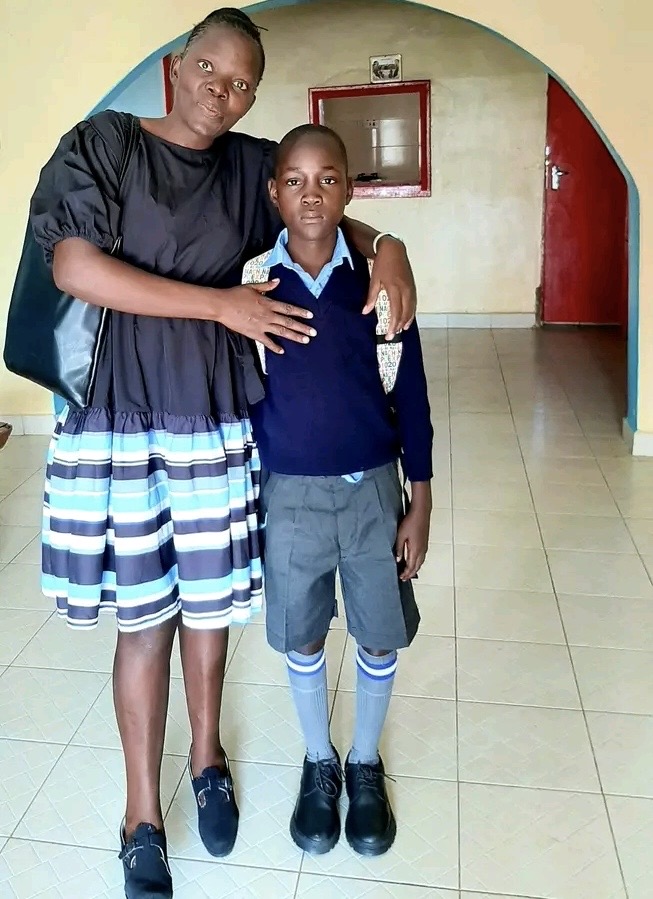
Mwalimu Pamela
Mrs. Amondi was born in 1996 in the town of Oyugis, Homa Bay County. We are grateful to this land and its people for bringing this extraordinary daughter to us. Her human, always professional approach in various situations has often helped us find reasonable and balanced solutions.
Our team of social workers is mostly composed of men. Pamela therefore brings an important female perspective into the handling of different situations. It has often been the case that her gentle and understanding approach helped us achieve reconciliation in relationships between the children in the centre and their families. Her presence has repeatedly contributed to calmer communication and more constructive outcomes in sensitive cases.
David Okoth Orwa
Teacher, Social Worker
David Okoth Orwa is a key member of our daily staff, responsible for supporting the education, structure, and overall daily functioning of the centre. He completed his secondary education at St. Vitalis Nanga Secondary School between 2014 and 2017.
David grew up within the same local community he now serves, which gives him a deep understanding of the children’s background, challenges, and environment. Having personally experienced the realities of life in this context, he is exceptionally well-equipped to respond to the needs of the boys with empathy, discipline, and practical solutions.
David represents a highly effective and naturally qualified educator for this environment. His strength lies in lived experience, cultural understanding, and strong personal connection to the community. He is a true mwenyeji – a local in the deepest sense of the word.
In his daily work, David is responsible for overseeing the daily schedule, supervising educational and leisure activities, and maintaining order and discipline within the centre. He also supports morning teaching sessions, helping children develop basic skills in literacy, numeracy, English, and Swahili.
Together with his colleagues, he plays an important role in guiding the children through their rehabilitation process, ensuring consistency, structure, and a stable environment.
During children’s free time, David is actively involved in their activities, including sports and group games, where he builds trust and strengthens positive relationships with them.
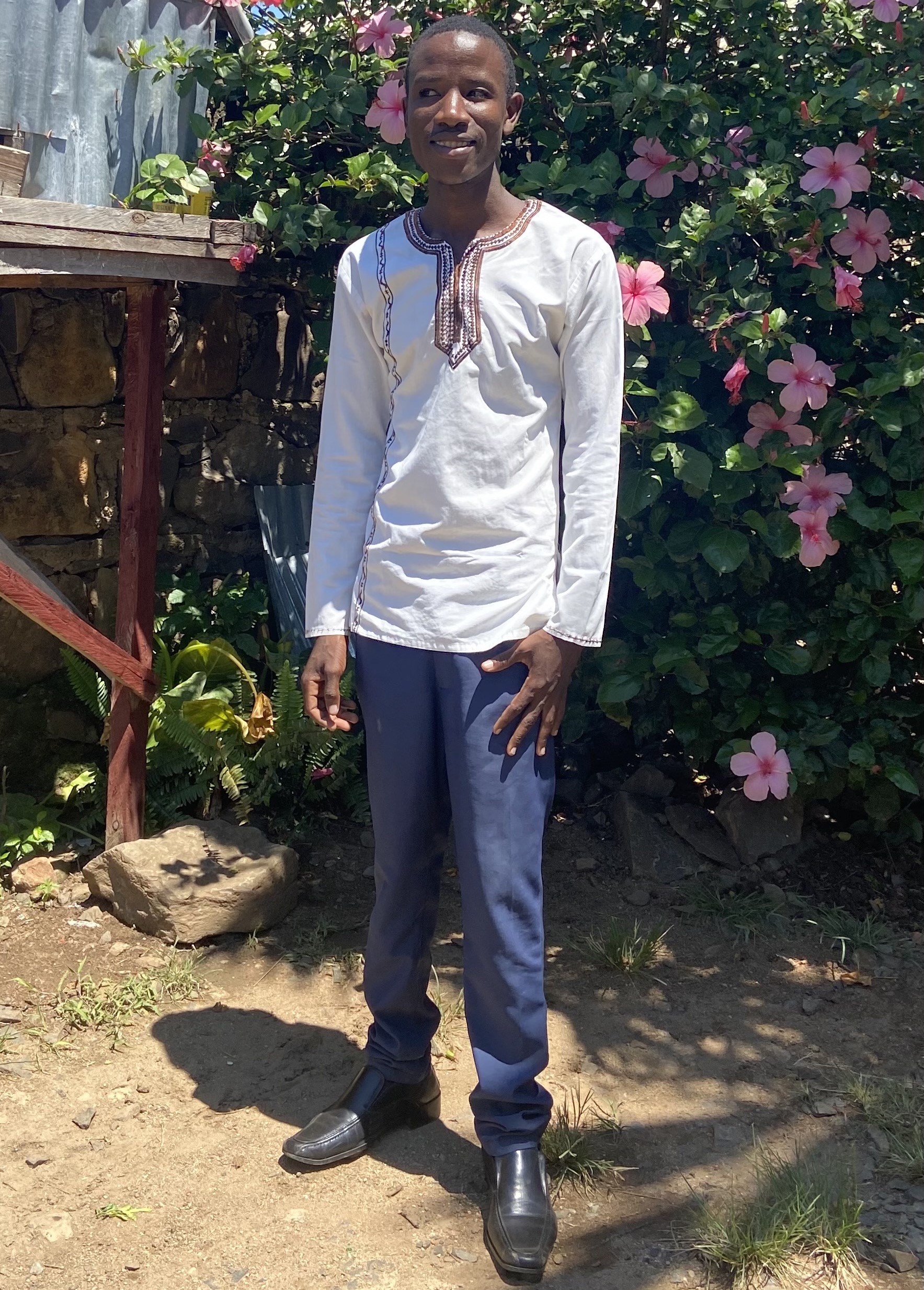
Odijo David
David Okoth Orwa was born in 1995 in Bondo, Siaya County. He is a member of the Luo community and has lived his entire life in this region, which gives him a deep understanding of local culture, language, and the realities of the children we work with. He is a true “mwenyeji” – a local in the fullest sense.
Raised in the same environment in which he now works, David communicates naturally with children and their families in Dholuo, Kiswahili, and English. His lived experience allows him to quickly build trust and serve as a strong link between the centre and the community.
Okoth Orwa brings essential practical knowledge and understanding of local conditions. He supports daily routines, education activities, and discipline within the centre, playing an important role in the children’s rehabilitation process.
Social Worker's Responsibility
Our social Workers are responsible for the guidance and communication in all phases of the rehabilitation/reintegration process and for comprehensive management of both moral and educational development of children on daily basis.
In addition, their purviews include the routine formal acts ensuring the functioning of the Center in accordance with the current requirements of the competent authorities.
New Cases
~ administration of the admission process 'step-by-step'
~ familiarization with the newly admitted children
~ informal interviews with a subsequent detailed record of the child's situation, its reason, family history and history of substance abuse (all in the child's native language)
~ registration of new admissions with all the competent authorities; continuous updating of official records
~ monitoring and management of the child's integration into the collective
~ elaboration of an individual tutoring plan based on the actual knowledge and age of the child
Daily Routine
~
~ overseeing and exaction of day-to-day duties such as upkeep of premises (washing dishes, making beds, hygiene, etc.), getting ready for school (schoolchildren, in the evening), or bedtime
~ individual basic-knowledge tutoring in the morning hours (according to the skill-level of new children, for the purpose of their future school attendance)
Moral Upbringing
~ monitoring and reporting on each child's behavior, coordinated management of possible problems (petty theft, misunderstandings)
~ performance of weekly collective and individual meetings with newly admitted children on this topic
~ inculcation of consideration and ethical habits and overseeing of their compliance- spontaneously and programmatically in free time, in exemplary situations, or ordinary conversations